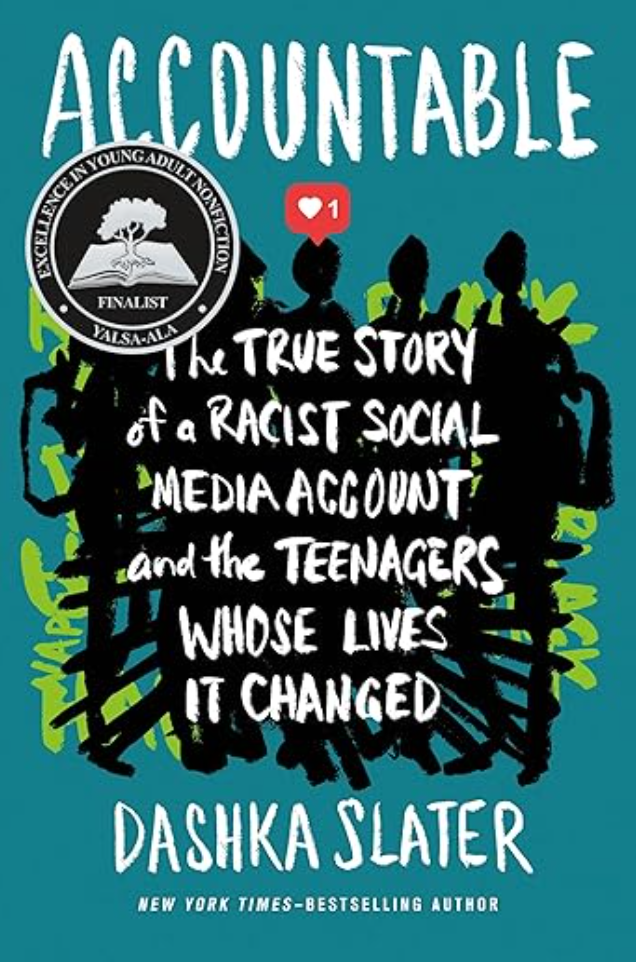
Accountable: Parts 8–10
Focusing on how a high school student's Instagram account shattered a small town in California, the author explores how much responsibility our society should have in preventing the spread of hateful ideas.
Here are links to our lists for the book: Prologue–Part 2, Parts 3–4, Parts 5–7, Parts 8–10, Parts 11–15
40 words
9 learners
Learn words with Flashcards and other activities
Definition First

Other learning activities
Full list of words from this list:
-
palpable
capable of being perceivedBut now the tension in the room was palpable.
-
unmitigated
not diminished or moderated in intensity or severityMaybe if they had met off campus, in a more neutral environment, away from the growing crowd of protesters in the hallway outside, or if participation had been limited to people directly involved with the account, or if the mediators had been more skilled. But as it was, the whole thing was a train wreck. An unmitigated disaster.
-
insolent
marked by casual disrespectBeing insolent was a way of being edgy, he says now, but it was also a reflection of how little importance he assigned to the girls and their feelings.
-
exacerbate
make worse“And that caused me to hold my tongue. At that point, I just wanted to be out of there and I didn’t want to say anything else that would further exacerbate the situation for me.”
-
condescension
showing arrogance by patronizing those considered inferiorWyatt tried to reply, but at some point he started to say “you people,” a phrase that can communicate white separateness and condescension.
-
haphazard
dependent upon or characterized by chanceAcross campus, school was proceeding in a haphazard fashion, with some teachers canceling classes and others soldiering on, even as fewer and fewer students showed up.
-
manifest
reveal its presence or make an appearance“I don’t know if he was trying to be violent toward anybody, but his anger was manifesting physically and his friends were doing all they could to try and calm him down and get him out of there.”
-
sequester
set apart from othersIn the rooms where they were sequestered, they could hear students pounding on the windows.
-
altercation
a noisy, angry argument or fight between peopleAt the end of the message, she mentioned having “been informed” that “there were altercations when students were exiting campus” and promised to conduct an investigation.
-
impervious
not admitting of passage or capable of being affectedThe whole point of shaming someone is to make them feel bad, particularly someone who seems like they’re not going to feel that way on their own, someone who seems impervious, impenetrable, unreachable.
-
pillory
a wooden instrument of punishment on a postThe pillory, a device for holding people in a stooped position while they were publicly taunted and tormented, wasn’t banned by Congress until 1839 and was still used from time to time until 1905.
-
sanction
the act of punishingSince then, public humiliation has periodically come back into favor, often popularized by tough-on-crime judges who think that shaming might succeed where other sanctions have failed.
-
inherently
in an essential mannerSome legal scholars have argued that public shaming is inherently bad for society because it normalizes cruelty and degrades human dignity.
-
languish
experience prolonged suffering in an unpleasant situation or placeThrow a tomato at the criminal languishing in the stocks in the public square and you’ve made a public statement that you yourself are a virtuous and upstanding citizen.
-
stigmatize
condemn or openly brand as disgracefulThey can accept your verdict, which can lead to long-term mental health problems, loss of self-esteem, substance abuse, and repeat offenses (“I’m a bad person, so I can’t help doing bad things”); they can shift blame by creating a narrative in which someone else is at fault and they are misunderstood or wrongly accused; or they can find people who will give them validation and praise for the exact behavior that caused other people to reject and stigmatize them.
-
profound
far-reaching and thoroughgoing in effect“The optics and sound will be profound,” Lewis wrote to the group, “and send a message that a ‘coalition of the willing’ is committed [to] find solutions to Diversity and Inclusion.”
-
atonement
the act of making amends for sin or wrongdoing“So far, our parent group has committed to continuing to meet together, to talking with our children about atonement and forgiveness, and to communicating with the community about our process.”
-
fait accompli
an irreversible accomplishmentWas expulsion a fait accompli? Did he think there were accomplices who deserved the same fate?
-
complicit
associated with or involved in some crime or wrongdoing“They are pleased that Charlie is taking all the blame and have assumed no responsibility for their child’s role,” he wrote. “That said, it would still give me no satisfaction to see others expelled however complicit they may be.”
-
discreet
not easily noticeable“The main thing the racist kid learns about racism from expulsion is to be more discreet about their racism,” he wrote.
-
indifferent
showing no care or concern in attitude or actionSome families were devastated by what their children were part of and were eager to make amends. Others were defensive or indifferent.
-
ardent
characterized by intense emotionAll of this had made him an ardent believer in both free speech and due process.
-
respite
a relief from harm or discomfortSpring break started on April 10, providing a much-needed respite for the entire school.
-
cohort
a group of people having approximately the same ageBut Albany was a relatively small school. Most classes had only one or two sections, and many of the students on both sides were in small programs where they spent the entire school day with one cohort.
-
pariah
a person who is rejected from society or home“I went from being a sociable person and kind of on top of everything,” he says, “to just instantly feeling like a pariah and unsafe to walk in my hometown. Did not want to be seen in public. Felt scared if I was seen in public. Just afraid to be out and be seen.”
-
smattering
a small number or amountThere was a smattering of applause.
-
ensue
take place or happen afterward or as a resultInstead, some back-and-forth ensued between Gabriel’s dad and other people in the room, with a woman in the audience telling him not to “perpetuate fear” by talking about his kid being afraid.
-
veneer
an outward appearance that is deliberately misleading“And I would have loved some privacy in my classroom when pictures were taken of me and compared to a gorilla,” Andrea said and the veneer of calm fell away.
-
harangue
address forcefullyIt was supposed to be a community conversation, but those who spoke chose not to converse. They came to badger, berate, lecture, and harangue.
-
discourse
extended verbal expression in speech or writingBut they’re also very much a manifestation of our pathology, of our sickness, of our weaknesses, of our lack of civil discourse, of our commitment to not seeing the impact of racism in our communities.
-
faction
a dissenting cliqueReally, two things are true: they need to be held responsible for their behavior and they also are probably going to get scapegoated, or used by various factions in the community to make statements about whatever people believe.
-
ostracize
expel from a community or groupThe school district, the complaint alleged, “would rather see students get socially ostracized to the point of effective expulsion and even physically beaten before sharing the truth about the student plaintiffs’ lack of involvement.”
-
litigate
engage in legal proceedingsBy the end of June, Murphy and Charles would both file lawsuits of their own, bringing the total of litigating students to ten.
-
compensate
make amends for“But I think the way [the school district] handled it was very bad and we should be compensated for their lack of knowledge on how to handle the situation. I think I do deserve some sort of punishment, and that’s totally fine if the expulsion stays on my record. So morally, it’s like if they handled it properly, I wouldn’t feel entitled to anything.”
-
facilitate
be of useAfter Greg’s mother’s plea for help at the April 25 school board meeting, Albany school officials had introduced both Greg’s parents and Andrea’s mother to a restorative justice facilitator named Kyle McClerkins, with the thought that McClerkins might facilitate a session between the two young people.
-
animosity
a feeling of ill will arousing active hostilityMcClerkins, who is Black, was good at opening up conversations about race—he did it all the time in his job as a restorative justice facilitator in the Oakland schools, where racial animosity often leaked into conflicts between students from different backgrounds.
-
substantial
fairly large“It can hardly be argued that either students or teachers shed their constitutional rights to freedom of speech or expression at the schoolhouse gate,” Supreme Court justice Abe Fortas wrote in the decision. Instead, the court held, school officials must prove that a student’s conduct would foreseeably lead to a substantial disruption of school operations.
-
derogatory
expressive of low opinion“I think the best nexus factor is the fact that it reached campus, it did get there,” she said, adding that if you talk about other students in a derogatory manner, somebody was likely to feel uncomfortable and tell other people.
-
qualm
uneasiness about the fitness of an actionHis qualm was this: According to the standard established by the Tinker case, a school can only discipline student speech if that speech would have a foreseeable and substantial disruptive effect. While that standard could be met for the original poster, he was having trouble seeing how it applied to people who liked or commented.
-
epithet
a defamatory or abusive word or phrase“Let’s say this happened on campus, and one student was yelling racial epithets at another student, and fifty students walked up and watched. And some of those students voiced vague but positive words of support like, yeah, right on, good point,” he said. “You think the school district, within the parameters of Tinker, could discipline the students who just gave the vague words of support?”
Created on Thu Jan 11 10:28:33 EST 2024
(updated Fri Jan 12 11:32:09 EST 2024)
Sign up now (it’s free!)
Whether you’re a teacher or a learner,
Vocabulary.com can put you or your class
on the path to systematic vocabulary improvement.