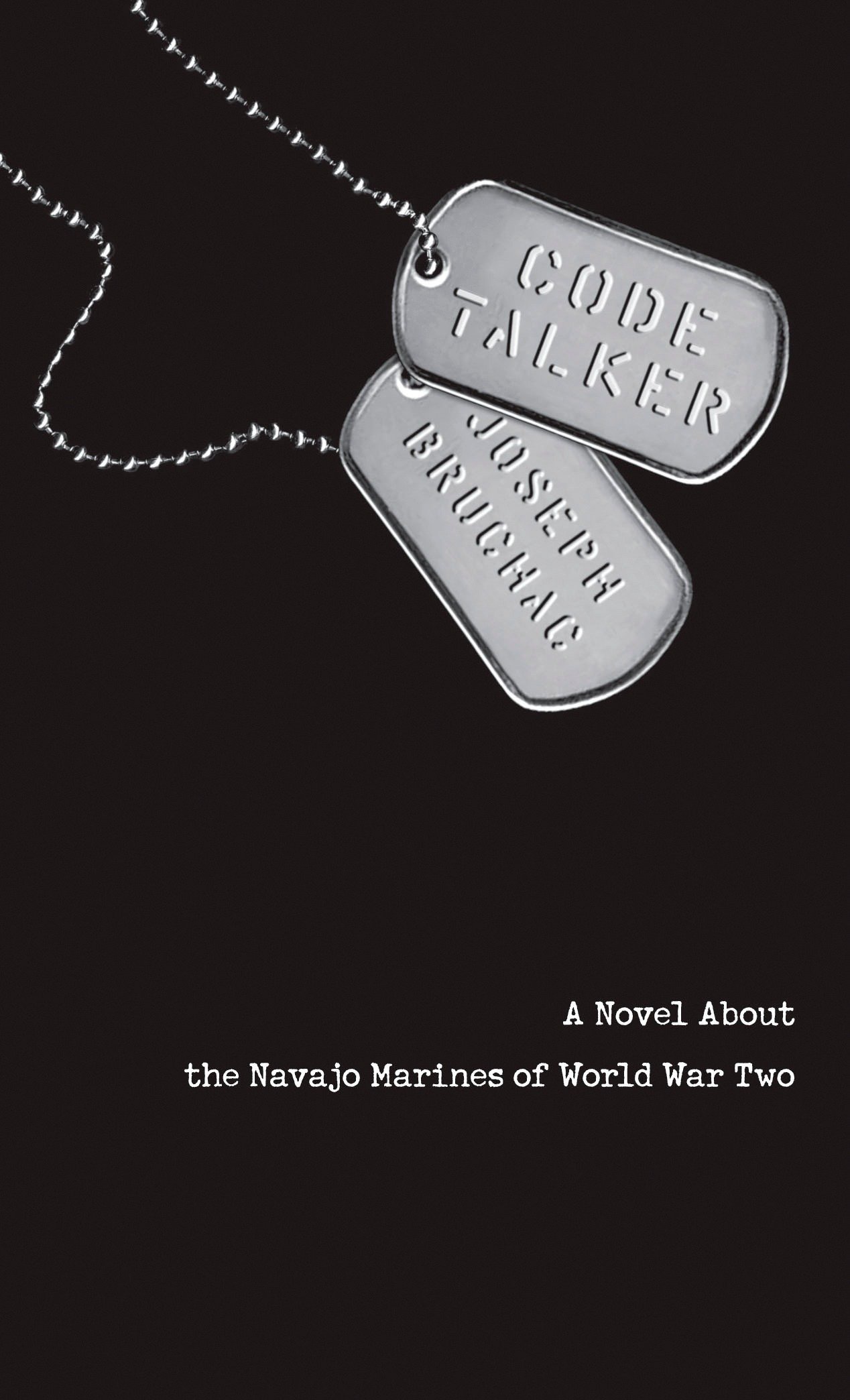
Code Talker: Chapters 13–17
Based on the true story of Navajo code talkers, this novel recounts the exploits of Ned Begay, a sixteen-year-old Navajo soldier in World War II. Ned's language skills prove to be invaluable as the Americans work to send secret messages to help them in their fight.
Here are links to our lists for book: Chapters 1–5, Chapters 6–12, Chapters 13–17, Chapters 18–23, Chapters 24–29
15 words
2112 learners
Learn words with Flashcards and other activities
Definition First

Other learning activities
Full list of words from this list:
-
amphibious
operating or living on land and in waterBy the end of August 1943, as our training ended, Admiral Nimitz was getting ready to stage amphibious assaults on the Gilbert Islands with the First and Second Marine divisions.Amphibious warfare involves delivering troops to shore via naval warships. Marines are military personnel that operate on both land and sea; they are part of the U.S. Navy, and are considered an amphibious force, as they serve both on land and at sea.
-
assault
close fighting during the culmination of a military attackBy the end of August 1943, as our training ended, Admiral Nimitz was getting ready to stage amphibious assaults on the Gilbert Islands with the First and Second Marine divisions.Because a modern military has many long-range weapons, close fighting often takes place towards the end of a planned attack. But in non-combat zones, an assault can take place at any time, and it can use physical or emotional weapons (such as speech or writing).
-
convoy
a procession of land vehicles traveling togetherThe Japanese often attacked American convoys with airplanes sent out from their aircraft carriers.
-
perimeter
the boundary line or area immediately inside the boundaryNext thing we knew, we were up near the front line perimeter.
-
caliber
diameter of a tube or gun barrelThey heard the crack of the .25 caliber rifles of hidden snipers, a sound very different from our own M1s.The numerical caliber of a gun measures either the diameter of its barrel or the diameter of its projectile (both should be closely matched). Because a gun has many parts, this number does not reveal much about its overall caliber ("a degree or grade of excellence or worth").
-
regiment
army unit smaller than a divisionI was with the Third Division, Ninth Regiment along with several other code talkers, including Bill Toledo.
-
bombardment
the heavy fire of artillery to saturate an areaThink about all the preliminary air strikes and naval bombardment before even boarding the landing crafts, those LCVPs (short for landing crafts for vehicles and personnel) and LCMs (short for landing crafts, mechanized) that we all just called “alligators.”
-
reconnaissance
the act of scouting, especially to gain informationAerial reconnaissance had revealed where the main concentrations of Japanese defenders seemed to be — in the southern part of the island.This noun is often shortened to "recon." As a verb, "recon" can refer to "reconnoiter," which is synonymous with "scout" and defined as "explore, often with the goal of finding something."
-
neutralize
make incapable of military actionWe could establish a defensible perimeter, build a new airfield, then gradually work our way out to neutralize the whole island.
-
sluggish
moving slowlyI kept checking my watch, uncertain if I wanted its sluggish hands to move faster or just stay still forever.
-
objective
the goal intended to be attainedOur objective was Blue Beach One, the landing zone closest to Cape Torokina.As an adjective, "objective" means "expressing things perceived without distortion of feelings." The narrator is sometimes objective in describing how the objectives of the war are attained, but he is not objective about war itself: "Never think that war is a good thing, grandchildren. Though it may be necessary at times to defend our people, war is a sickness that must be cured."
-
hone
sharpen with a whetstoneWe could hear the sound of whetstones being drawn along blades as some of the other Marines sitting on the decks behind us honed their already razor-sharp knives and bayonets.
-
salvo
rapid simultaneous discharge of firearmsThe Anthony's five-inchers roared off two-gun salvos, one after another, though no return fire answered.In Latin, "salve" means "be in good health." This can be seen in another definition of "salvo": a sudden outburst of cheers. The word's connection to combat comes from the Roman practice of greeting important visitors with a volley of gunfire in the air.
-
ambush
the act of hiding and waiting to make a surprise attackThe sounds of firing were still all around me as the Japanese continued to cover the beach with their well-planned ambush.
-
echelon
a body of troops arranged in a lineEverything from the rear echelon to the forward echelon and back was sent through us.
Created on Wed Dec 09 14:04:09 EST 2015
(updated Tue Jun 17 17:12:00 EDT 2025)
Sign up now (it’s free!)
Whether you’re a teacher or a learner,
Vocabulary.com can put you or your class
on the path to systematic vocabulary improvement.