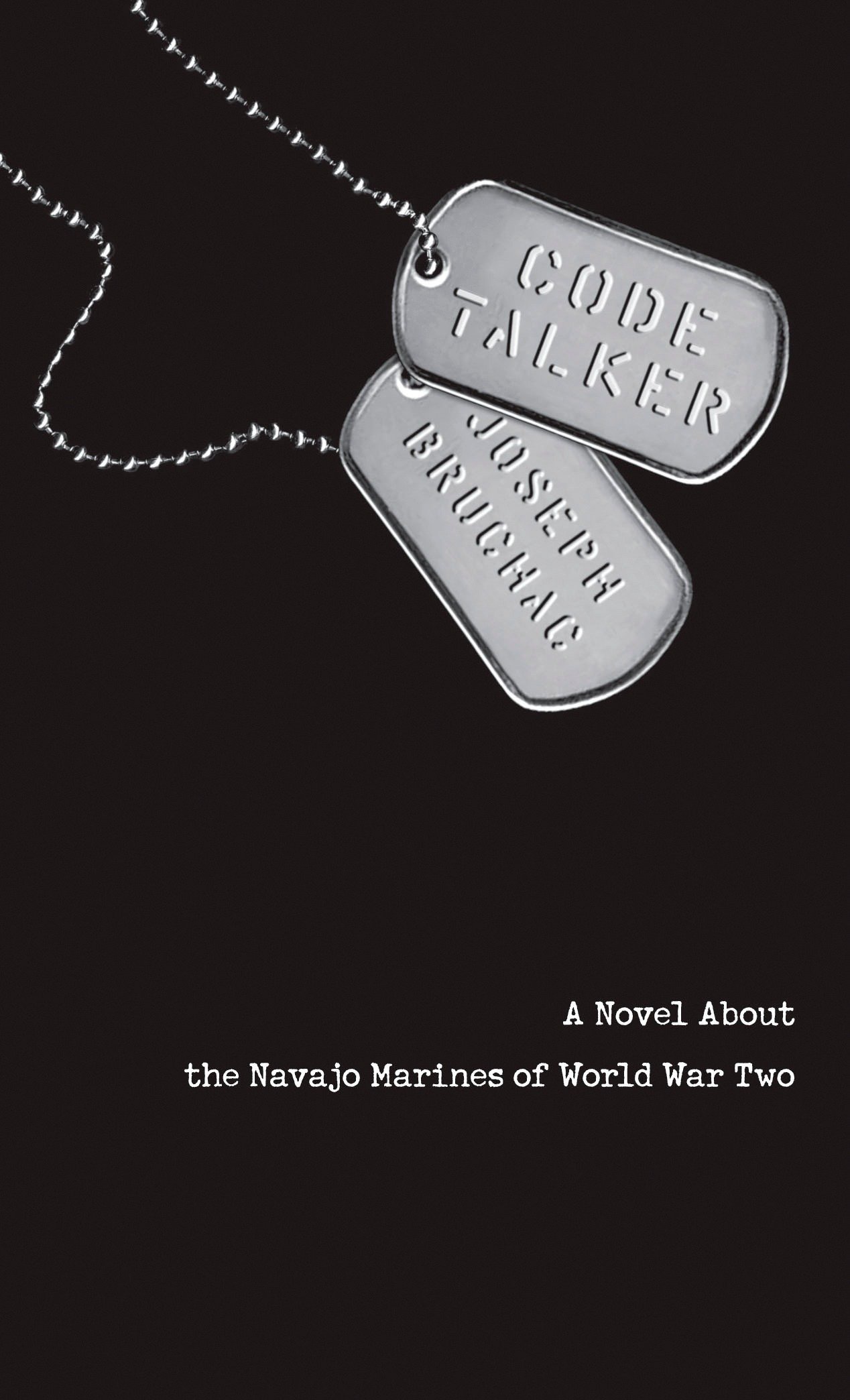
Code Talker: Chapters 6–12
Based on the true story of Navajo code talkers, this novel recounts the exploits of Ned Begay, a sixteen-year-old Navajo soldier in World War II. Ned's language skills prove to be invaluable as the Americans work to send secret messages to help them in their fight.
Here are links to our lists for book: Chapters 1–5, Chapters 6–12, Chapters 13–17, Chapters 18–23, Chapters 24–29
15 words
2974 learners
Learn words with Flashcards and other activities
Definition First

Other learning activities
Full list of words from this list:
-
resolve
reach a conclusion after a discussion or deliberationNow, therefore, we resolve that the Navajo Indians stand ready as they did in 1918, to aid and defend our government, and its institutions against all subversion and armed conflict and pledge our loyalty to the system which recognizes minority rights and a way of life that has placed us among the greatest people of our race.As a noun, "resolve" is synonymous with "determination"; this meaning can be seen in the Navajo Tribal Council's resolution to aid and defend. As a verb, "resolve" also means "bring to an end; settle conclusively." Despite what the government had done to the tribe in the past, the resolution seeks to resolve any conflict about the Navajo Indians' identity and loyalty as Americans.
-
enlist
join the military“This war will be over,” I said to my friends, “before I am old enough to enlist.”
-
fluent
expressing yourself readily, clearly, effectivelyHowever, only men fluent in both English and Navajo were wanted.
-
impressive
making a strong or vivid mental imageHe was Corporal Johnny Manuelito of the 382nd and he wore the bright, impressive uniform of a U.S. Marine.
-
reverberate
ring or echo with soundWhen he came to our high school and spoke to the student body, his words reverberated in my mind like drumbeats.
-
obstacle
an obstruction that stands in the wayIt’s too hard for your average man to get used to marching long distances and carrying heavy packs, to running and climbing obstacles.
-
recruit
a recently enlisted soldierThose things that he said a Marine recruit needed to learn were part of our everyday Navajo life back then.
-
routine
an unvarying or habitual method or procedureThere was a routine to every day. All I had to do was listen closely and follow orders.As an adjective, "routine" means "found in the ordinary course of events" and is often used as a synonym for "boring." But the narrator does not have a negative attitude towards the routine of boot camp, because each day brings another physical challenge where the Navajos can prove they are the best.
-
calisthenics
light exercises designed to promote general fitnessRunning, climbing, and doing calisthenics were easy for me.
-
cadence
a recurrent rhythmical seriesWhen you march in the Marines, you count in English like this: “One, two, three, four, one, two, three, four.” That is called counting cadence. One day, though, our white sergeant ordered me to count cadence in Navajo.
-
flounder
have difficulties; behave awkwardlyThose who floundered or panicked were pulled out, had the water pumped out of them, and then were pushed back in again.As a noun, "flounder" is a type of flatfish. A flounder should not flounder in the water. Neither should a Marine. Although the meaning of the verb normally does not connect to its meaning as a noun, the example sentence suggests the pun. This is also seen in the description where the narrator admits that the drill and swimming instructors had to jump into the pool and "fish me out."
-
classify
declare unavailable, as for security reasonsWhile it remained classified, not one of us ever told about the code, not even to our families.Information that is classified is top-secret. If the narrator "breathed a word about the very existence of the code to an outsider, even to another Navajo Marine who was not a code talker," he could be locked in a brig (a jail on a ship) for the rest of the war.
-
assign
decide as to where something belongs in a schemeOne of our jobs of our second class of Navajo code talkers was to assign more Navajo words to the letters of the English alphabet that are used most often.In the military, a soldier is assigned to a unit, in which he is assigned tasks. In the narrator's case, he was assigned to the signal corps of the Third Division, Second Regiment, Third Battalion, to a landing party, and to a unit moving inland. These assignments as a Navajo code talker, stretcher bearer, water carrier (whatever was needed) contrast with those he had once handed in to his teachers in perfect English.
-
frequency
the number of occurrences within a given time periodThat is because people who break codes can sometimes do so by hearing or seeing the same sound or symbol appearing many times. They call this “word frequency.”A more technical definition of "frequency" is "the rate at which a vibration occurs that constitutes a wave, either in a material (as in sound waves), or in an electromagnetic field (as in radio waves and light), usually measured per second." Before using the radio to send a message, a code talker must first "tune the set to the right frequency."
-
bayonet
a knife fixed to the end of a rifle and used as a weaponAnd just to let him know that we were really training hard, every now and then one of us would shove a bayonet through the wall of the tent near wherever he had taken refuge.
Created on Wed Dec 09 13:36:40 EST 2015
(updated Tue Jun 17 15:56:05 EDT 2025)
Sign up now (it’s free!)
Whether you’re a teacher or a learner,
Vocabulary.com can put you or your class
on the path to systematic vocabulary improvement.