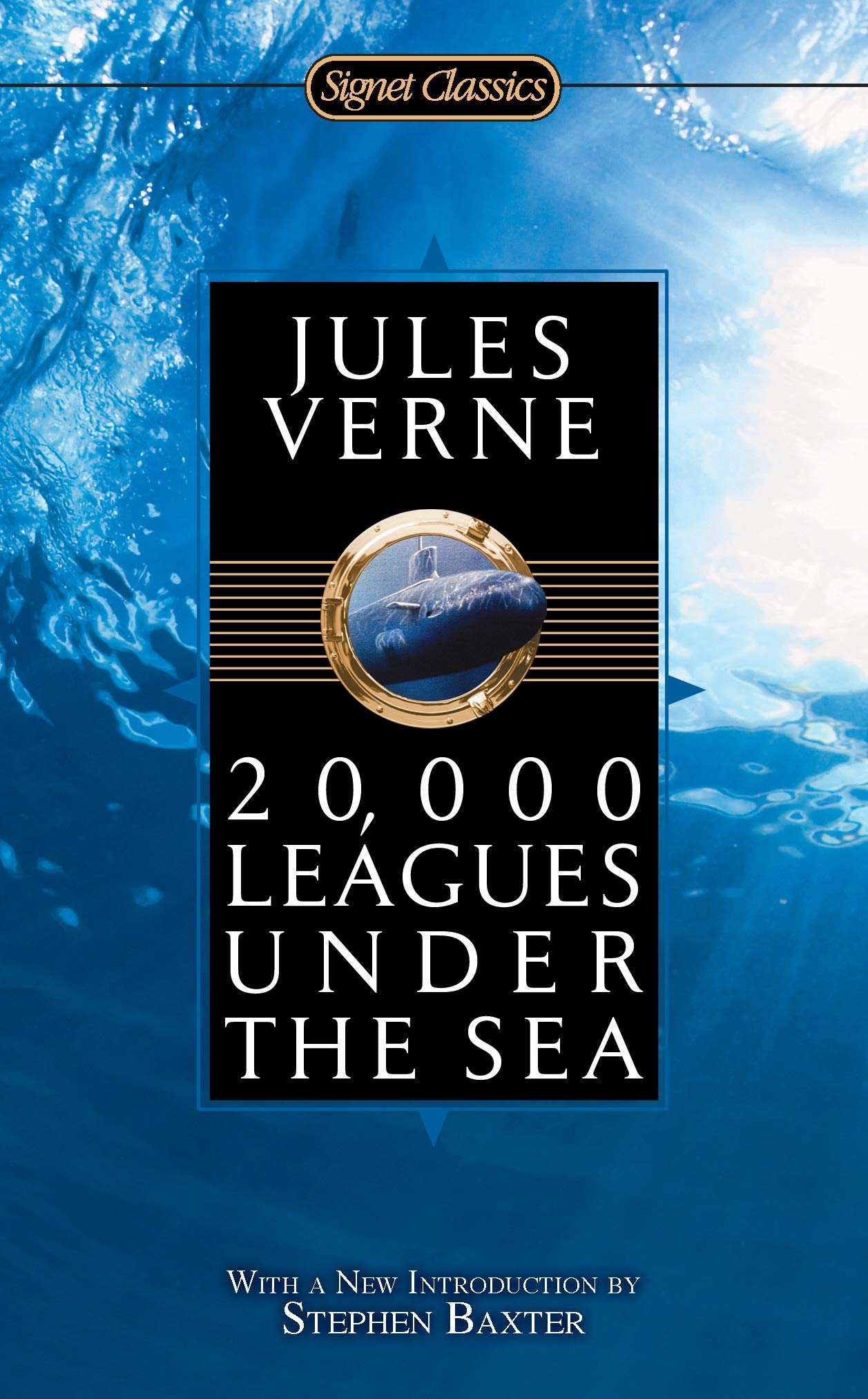
Twenty Thousand Leagues Under the Sea: Second Part: Chapters 8–14
Board the Nautilus and travel under the sea with the mysterious Captain Nemo as you learn these words from the science fiction novel by Jules Verne. Read the full text, translated from the original French by F.P. Walter, here.
Here are links to our lists for the novel: First Part: Chapters 1–8, First Part: Chapters 9–16, First Part: Chapters 17–24, Second Part: Chapters 1–7, Second Part: Chapters 8–14, Second Part: Chapters 15–23
40 words
87 learners
Learn words with Flashcards and other activities
Definition First

Other learning activities
Full list of words from this list:
-
research
systematic investigation to establish factsWhat an agonizing day I spent, torn between my desire to regain my free will and my regret at abandoning this marvelous Nautilus, leaving my underwater research incomplete!
-
reveal
make known to the public information previously kept secretHow could I relinquish this ocean—"my own Atlantic," as I liked to call it—without observing its lower strata, without wresting from it the kinds of secrets that had been revealed to me by the seas of the East Indies and the Pacific!
-
conjecture
the formation of conclusions from incomplete evidenceIn these strange circumstances the scope for conjecture was unlimited.
-
unravel
disentangleFrom this collection of portraits could I finally unravel the mystery of his existence?
-
resolve
find a solution or answerThis piece of history concerns you in one definite respect, because it will answer a question you've no doubt been unable to resolve.
-
probe
question or examine thoroughly and closely"Well, Professor Aronnax," Captain Nemo answered me, "we're actually in that Bay of Vigo, and all that's left is for you to probe the mysteries of the place."
-
unaware
not having or showing knowledge or understandingDo you think I'm unaware of the suffering beings and oppressed races living on this earth, poor people to comfort, victims to avenge?
-
inexplicable
incapable of being explained or accounted forThose piles of stones just mentioned were laid out on the ocean floor with a distinct but inexplicable symmetry.
-
unfathomable
impossible to come to understandThe rocky mass was gouged with impenetrable crevices, deep caves, unfathomable holes at whose far ends I could hear fearsome things moving around.
-
distinguish
detect with the sensesThey were huge stacks of stones in which you could distinguish the indistinct forms of palaces and temples, now arrayed in hosts of blossoming zoophytes, and over it all, not ivy but a heavy mantle of algae and fucus plants.
-
principle
a rule or law concerning a natural phenomenonFlames need oxygen from the air and are unable to spread underwater; but a lava flow, which contains in itself the principle of its incandescence, can rise to a white heat, overpower the liquid element, and turn it into steam on contact.
-
philosopher
a specialist in the investigation of existence and knowledgeAtlantis, that ancient land of Meropis mentioned by the historian Theopompus; Plato's Atlantis; the continent whose very existence has been denied by such philosophers and scientists as Origen, Porphyry, Iamblichus, d'Anville, Malte–Brun, and Humboldt, who entered its disappearance in the ledger of myths and folk tales
-
unimpeachable
beyond doubt or reproachI had this land right under my eyes, furnishing its own unimpeachable evidence of the catastrophe that had overtaken it!
-
commentary
a written explanation or criticism or illustrationBut Conseil was so distracted he barely heard me, and his lack of interest in any commentary on this historical topic was soon explained.
-
satisfied
filled with contentmentOur beacon is about to go on, and if you want some light on the subject, you'll be satisfied.
-
recognize
detect with the sensesI recognized some spurges that let their caustic, purgative sap trickle out.
-
flora
all the plant life in a particular region or periodThere the local flora was represented by a wide carpet of samphire, a small umbelliferous plant that keeps quite nicely, which also boasts the names glasswort, saxifrage, and sea fennel.
-
fauna
all the animal life in a particular region or periodAs for the local fauna, it included thousands of crustaceans of every type: lobsters, hermit crabs, prawns, mysid shrimps, daddy longlegs, rock crabs, and a prodigious number of seashells, such as cowries, murex snails, and limpets.
-
expert
a person with special knowledge who performs skillfullyAnd here's why these water plants collect in this placid Atlantic basin, according to the expert on the subject, Commander Maury, author of The Physical Geography of the Sea.
-
formulation
the act of inventing or contriving an idea or explanationHe had thumbed through my work on the great ocean depths, and the margins were covered with his notes, which sometimes contradicted my theories and formulations.
-
specimen
an example regarded as typical of its classChief among them were specimens of that dreadful cartilaginous genus that's divided into three subgenera numbering at least thirty–two species: striped sharks five meters long, the head squat and wider than the body, the caudal fin curved, the back with seven big, black, parallel lines running lengthwise; then perlon sharks, ash gray, pierced with seven gill openings, furnished with a single dorsal fin placed almost exactly in the middle of the body.
-
species
taxonomic group whose members can interbreedSome big dogfish also passed by, a voracious species of shark if there ever was one.
-
genus
taxonomic group containing one or more speciesThe family Delphinia numbers ten genera, and the dolphins I saw were akin to the genus Delphinorhynchus, remarkable for an extremely narrow muzzle four times as long as the cranium.
-
presume
take to be the case or to be true"But given the current state of marine science, who are we to presume, what do we really know of these depths?"
-
hunch
an impression that something might be the case"Because," I said, "if I can trust my hunches, if I truly understand the captain's way of life, his Nautilus isn't simply a ship. It's meant to be a refuge for people like its commander, people who have severed all ties with the shore."
-
data
a collection of facts from which conclusions may be drawnMaster is familiar with the ship's capacity, hence the amount of air it contains; on the other hand, Master knows how much air each man consumes in the act of breathing, and he can compare this data with the fact that the Nautilus must rise to the surface every twenty–four hours
-
skeptical
marked by or given to doubt"Oh, professor, what are you feeding me?" the Canadian answered in a tolerably skeptical tone.
"I'm feeding you the facts." -
logic
a system of reasoningPeople don't know so, they suppose so, and here's the logic with which they back up their beliefs. When fishermen first hunted whales 400 years ago, these animals grew to bigger sizes than they do today. Reasonably enough, it's assumed that today's whales are smaller because they haven't had time to reach their full growth.
-
lecture
a long speech that scolds or reprimandsI'll let the reader decide what faces the Canadian made during this lecture on hunting ethics.
-
familiar
well informed about or knowing thoroughlyHaving fished in the Arctic seas, Ned Land was already familiar with the sight of icebergs.
-
classify
arrange or order by categoriesGuided by his skillful hands, the Nautilus passed by all these different masses of ice, which are classified by size and shape with a precision that enraptured Conseil: "icebergs," or mountains; "ice fields," or smooth, limitless tracts; "drift ice," or floating floes; "packs," or broken tracts, called "patches" when they're circular and "streams" when they form long strips.
-
assume
take to be the case or to be trueThe cold–temperature poles and the geographical poles don't coincide in either the northern or southern hemispheres, and until proof to the contrary, we can assume these two spots on the earth feature either a continent or an ice–free ocean.
-
incomprehensible
difficult to understandThe two men held a quick exchange in their incomprehensible language, and either the chief officer had been alerted previously or he found the plan feasible, because he showed no surprise.
-
terminology
a system of words used to name things in a disciplineIndeed, we had "struck bottom," to use nautical terminology, but in the opposite direction and at a depth of 3,000 feet.
-
hypothesis
a proposal intended to explain certain facts or observationsThe existence of this shore seemed to bear out Commander Maury's hypotheses.
-
conclusion
a position or opinion reached after considerationFrom this fact he drew the conclusion that the Antarctic Circle must contain considerable shores, since icebergs can't form on the high seas but only along coastlines.
-
scholarly
characteristic of a learned person"Two genera," our scholarly Conseil hastened to say, "that belong to the family Pinnipedia, order Carnivora, group Unguiculata, subclass Monodelphia, class Mammalia, branch Vertebrata."
-
cerebral
of or relating to the brainI drew Conseil's attention to the considerable growth of the cerebral lobes found in these intelligent cetaceans. No mammal except man has more abundant cerebral matter.
-
naturalist
a biologist knowledgeable about botany and zoologyAccordingly, seals are quite capable of being educated; they make good pets, and together with certain other naturalists, I think these animals can be properly trained to perform yeoman service as hunting dogs for fishermen.
-
survey
determining opinions by interviewing peopleConseil and I stayed behind until five o'clock, surveying the beach, observing and studying.
Created on Fri Mar 03 15:47:37 EST 2017
(updated Tue Sep 25 15:23:36 EDT 2018)
Sign up now (it’s free!)
Whether you’re a teacher or a learner,
Vocabulary.com can put you or your class
on the path to systematic vocabulary improvement.