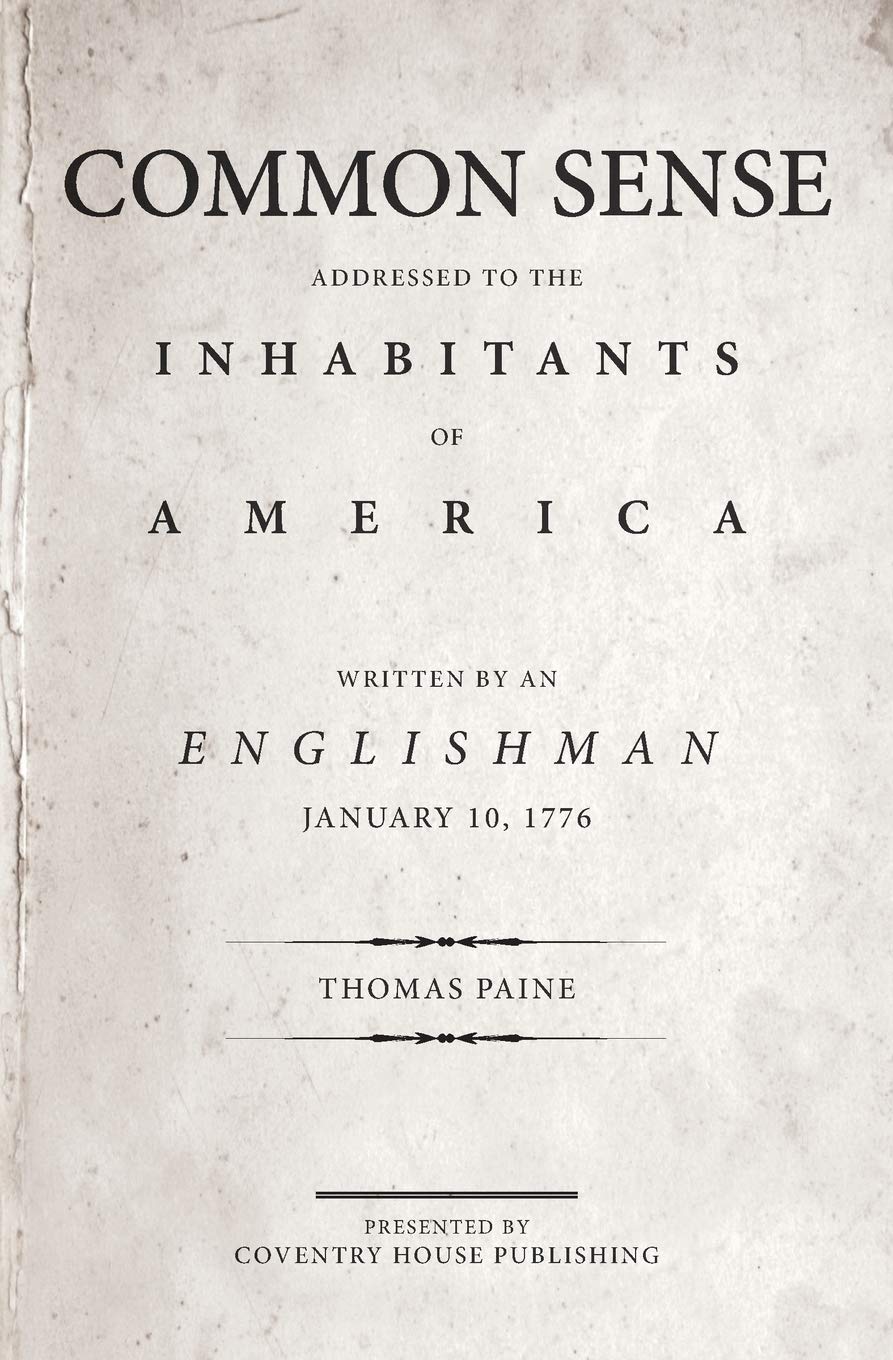
Common Sense: List 1
In this pamphlet, Paine urges the American colonists to fight for independence from Great Britain and form a new government. Read the full text here.
This list covers the "Introduction"–"Of Monarchy and Hereditary Succession."
Here are links to our lists for the text: List 1, List 2
25 words
2443 learners
Learn words with Flashcards and other activities
Definition First

Other learning activities
Full list of words from this list:
-
pretension
the advancing of a claim...as the King of England hath undertaken in his own Right, to support the Parliament in what he calls Theirs, and as the good people of this country are grievously oppressed by the combination, they have an undoubted privilege to inquire into the pretensions of both, and equally to reject the usurpation of either.
-
censure
harsh criticism or disapprovalIn the following sheets, the author hath studiously avoided every thing which is personal among ourselves. Compliments as well as censure to individuals make no part thereof.
-
injudicious
lacking or showing lack of judgment or discretion; unwiseThe wise, and the worthy, need not the triumph of a pamphlet; and those whose sentiments are injudicious, or unfriendly, will cease of themselves unless too much pains are bestowed upon their conversion.
-
extirpate
destroy completely, as if down to the rootsThe laying a Country desolate with Fire and Sword, declaring War against the natural rights of all Mankind, and extirpating the Defenders thereof from the Face of the Earth, is the Concern of every Man to whom Nature hath given the Power of feeling...
-
confound
mistake one thing for anotherSome writers have so confounded society with government, as to leave little or no distinction between them; whereas they are not only different, but have different origins.
-
prudence
discretion in practical affairsFor were the impulses of conscience clear, uniform, and irresistibly obeyed, man would need no other lawgiver; but that not being the case, he finds it necessary to surrender up a part of his property to furnish means for the protection of the rest; and this he is induced to do by the same prudence which in every other case advises him out of two evils to choose the least.
-
remiss
failing in what duty requires...but as nothing but heaven is impregnable to vice, it will unavoidably happen, that in proportion as they surmount the first difficulties of emigration, which bound them together in a common cause, they will begin to relax in their duty and attachment to each other; and this remissness, will point out the necessity, of establishing some form of government to supply the defect of moral virtue.
-
propriety
correct behaviorIf the colony continue increasing, it will become necessary to augment the number of the representatives, and that the interest of every part of the colony may be attended to, it will be found best to divide the whole into convenient parts, each part sending its proper number; and that the elected might never form to themselves an interest separate from the electors, prudence will point out the propriety of having elections often...
-
maxim
a saying that is widely accepted on its own meritsI draw my idea of the form of government from a principle in nature, which no art can overturn, viz. that the more simple any thing is, the less liable it is to be disordered; and the easier repaired when disordered; and with this maxim in view, I offer a few remarks on the so much boasted constitution of England.
-
formidable
extremely impressive in strength or excellenceIndividuals are undoubtedly safer in England than in some other countries, but the will of the king is as much the law of the land in Britain as in France, with this difference, that instead of proceeding directly from his mouth, it is handed to the people under the more formidable shape of an act of parliament.
-
prepossession
an opinion formed beforehand without adequate evidence...any prepossession in favour of a rotten constitution of government will disable us from discerning a good one.
-
recourse
something or someone turned to for assistance or securityMankind being originally equals in the order of creation, the equality could only be destroyed by some subsequent circumstance; the distinctions of rich, and poor, may in a great measure be accounted for, and that without having recourse to the harsh ill sounding names of oppression and avarice.
-
avarice
extreme greed for material wealthOppression is often the consequence, but seldom or never the means of riches; and though avarice will preserve a man from being necessitously poor, it generally makes him too timorous to be wealthy.
-
impious
lacking piety or reverence for a godThe Heathens paid divine honors to their deceased kings, and the christian world hath improved on the plan by doing the same to their living ones. How impious is the title of sacred majesty applied to a worm, who in the midst of his splendor is crumbling into dust!
-
exalt
raise in rank, character, or statusAs the exalting one man so greatly above the rest cannot be justified on the equal rights of nature, so neither can it be defended on the authority of scripture; for the will of the Almighty, as declared by Gideon and the prophet Samuel, expressly disapproves of government by kings.
-
encomium
a formal expression of praiseThis accounts for the continuation of monarchy; neither do the characters of the few good kings which have lived since, either sanctify the title, or blot out the sinfulness of the origin; the high encomium given of David takes no notice of him officially as a king, but only as a man after God’s own heart.
-
equivocal
open to two or more interpretationsThese portions of scripture are direct and positive. They admit of no equivocal construction. That the Almighty hath here entered his protest against monarchical government is true, or the scripture is false.
-
posterity
all future generationsTo the evil of monarchy we have added that of hereditary succession; and as the first is a degradation and lessening of ourselves, so the second, claimed as a matter of right, is an insult and an imposition on posterity.
-
depredation
an act of plundering and pillaging and marauding...we should find the first of them nothing better than the principal ruffian of some restless gang, whose savage manners or pre-eminence in subtility obtained him the title of chief among plunderers; and who by increasing in power, and extending his depredations, over-awed the quiet and defenceless to purchase their safety by frequent contributions.
-
extant
still in existence; not extinct or destroyed or lostWherefore, hereditary succession in the early ages of monarchy could not take place as a matter of claim, but as something casual or complimental; but as few or no records were extant in those days, and traditional history stuffed with fables, it was very easy, after the lapse of a few generations, to trump up some superstitious tale, conveniently timed, Mahomet like, to cram hereditary right down the throats of the vulgar.
-
sophist
someone whose reasoning is subtle and often speciousFor as in Adam all sinned, and as in the first electors all men obeyed; as in the one all mankind were subjected to Satan, and in the other to Sovereignty; as our innocence was lost in the first, and our authority in the last; and as both disable us from reassuming some former state and privilege, it unanswerably follows that original sin and hereditary succession are parallels. Dishonorable rank! Inglorious connexion! Yet the most subtile sophist cannot produce a juster simile.
-
usurpation
wrongfully seizing and holding by forceAs to usurpation, no man will be so hardy as to defend it; and that William the Conqueror was an usurper is a fact not to be contradicted. The plain truth is, that the antiquity of English monarchy will not bear looking into.
-
insolent
not held back by conventional ideas of behaviorMen who look upon themselves born to reign, and others to obey, soon grow insolent; selected from the rest of mankind their minds are early poisoned by importance; and the world they act in differs so materially from the world at large, that they have but little opportunity of knowing its true interests, and when they succeed to the government are frequently the most ignorant and unfit of any throughout the dominions.
-
miscreant
a person without moral scruples...the throne is subject to be possessed by a minor at any age; all which time the regency, acting under the cover of a king, have every opportunity and inducement to betray their trust. The same national misfortune happens, when a king worn out with age and infirmity, enters the last stage of human weakness. In both these cases the public becomes a prey to every miscreant, who can tamper successfully with the follies either of age or infancy.
-
ensue
take place or happen afterward or as a resultFor it is the republican and not the monarchical part of the constitution of England which Englishmen glory in, viz. the liberty of choosing a house of commons from out of their own body—and it is easy to see that when republican virtue fails, slavery ensues.
Created on Tue Aug 03 17:38:23 EDT 2021
(updated Wed Aug 04 15:39:14 EDT 2021)
Sign up now (it’s free!)
Whether you’re a teacher or a learner,
Vocabulary.com can put you or your class
on the path to systematic vocabulary improvement.