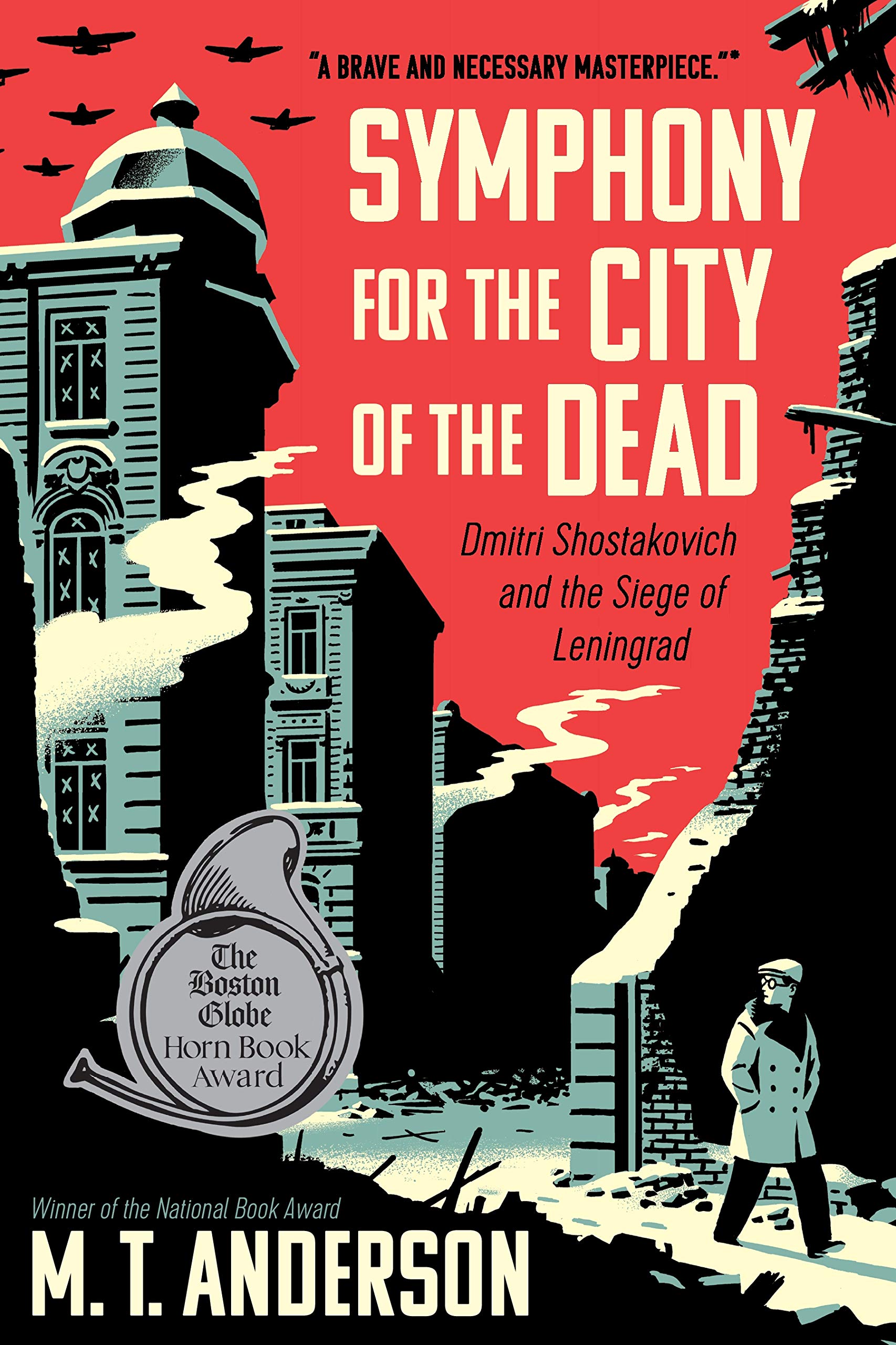
Symphony for the City of the Dead: Prologue–Part One
In 1941, composer Dmitri Shostakovich wrote a symphony in response to the relentless Siege of Leningrad. M.T. Anderson explores both the siege and Shostakovich's work in this award-winning nonfiction account.
Here are links to our lists for the book: Prologue–Part One, Part Two, Part Three
45 words
209 learners
Learn words with Flashcards and other activities
Definition First

Other learning activities
Full list of words from this list:
-
strafe
attack from above with machine guns or cannon fireGermans rained down incendiary bombs on the roofs and strafed the squares and avenues during nightly air raids.
-
cohort
a company of companions or supportersGerman high command felt it would be too costly to feed all the prisoners of Leningrad if they were captured, and Hitler considered the Russian Slavs, like the Jews, to be an inferior race, fit only for slavery or extermination. His vision was to make “room to live” for his Aryan cohorts.
-
bastion
a stronghold for shelter during a battleWhen I walk through our city a feeling of deep conviction grows within me that Leningrad will always stand, grand and beautiful, on the banks of the Neva, that it will always be a bastion of my country, that it will always be there to enrich the fruits of culture.
-
toady
try to gain favor by cringing or flatteringShe is governed by the most skillful intriguers at the tsar’s Court, by the most artful tricksters, by those who carry lies and slanders to the tsar, and flatter and toady to him.
-
pogrom
organized persecution of an ethnic group, especially JewsOn the other hand, stark realities glared through the mists of fantasy: Shostakovich’s mother, Sofia, sheltered Jews who were fleeing from the bloody anti-Semitic pogroms that wracked the countryside.
-
abject
most unfortunate or miserableAnger at the regime extended from those living in abject poverty to some of the wealthiest families.
-
dirge
a song or hymn of mourning as a memorial to a dead personThe coffins were covered with red flags, and the throngs sang a dirge: “You fell victims in the fatal struggle of selfless love for the people...."
-
requisition
demand and take for use or serviceThe houses of the wealthy and the middle class—the bourgeoisie—were ransacked for goods that could be requisitioned for the people’s fight, or simply looted in the name of the Revolution.
-
bourgeoisie
a socioeconomic group that is neither wealthy nor poorHe believed that Russia was only the first country of many that would soon overthrow its government and the control of the bourgeoisie (the middle class—which, incidentally, included the Shostakoviches) in favor of rule by the working class, the proletariat.
-
proletariat
a social class comprising those who do manual laborIn nation after nation, the working class, the proletariat, would rise up and toss aside their masters.
-
conservatory
a schoolhouse with special facilities for fine artsIt was through Glazunov that Sofia Shostakovich somehow got her Mitya into the Petrograd Conservatory to study piano at the very young age of thirteen.
-
rococo
having excessive asymmetrical ornamentationWhat would music sound like now that it was no longer being played in the salons of the rich? What would painting look like when it did not have to adorn the Rococo walls of Russian palaces?
-
avant-garde
radically new or originalThe most avant-garde among them now created pieces full of dark, knotted chords and thunderous declarations, or music like sculptures of crystal: sharp, hard structures with jutting spikes and dazzling surfaces.
-
mawkish
very sentimental or emotionalMayakovsky crowed, “Spit on rhymes and arias and the rose bush and other such mawkishness from the arsenal of the arts....Give us new forms!”
-
lucre
informal term for money“If you love art, young man, then how can you talk to me now about filthy lucre?” ...I tried to tell him that I needed the money.
-
pathos
a quality that arouses emotions, especially pity or sorrowCrowds all over the world were delighted by its playfulness and pathos.
-
cogitation
attentive consideration and thoughtYou have profound cogitation of the Word. And where the Word comes to an end, there begins Music.
-
epitomize
embody the essential characteristics ofShostakovich later remembered: “I can readily say that Mayakovsky epitomized all the traits of character I detest: phoniness, love of self-advertisement, lust for the good life, and most important, contempt for the weak and servility before the strong. Power was the great moral law for Mayakovsky.”
-
liaison
a means of communication between groupsNow Mayakovsky’s Communist Party liaison was complaining about the poet’s rampant individualism, his income, and his affair with a tsarist noblewoman.
-
harangue
address forcefullyOn April 14, 1930, Mayakovsky spent the morning as he often did, haranguing a girlfriend and trying to convince her to leave her husband. He bickered until she agreed to move in with him later that day.
-
attache
a specialist assigned to the staff of a diplomatic missionWe do not know if he meant what he said; sitting around him on his mother’s sofa were not only the American interviewer but also an official government translator and a Soviet press attaché, who would have reported anything questionable to their superiors.
-
vaudeville
a genre of variety show with songs, comic acts, etc.In 1931, Shostakovich provided music for Declared Dead, a similar chemical warfare training session, but combined with a vaudeville show. It featured simulated air raids, clowns, trapeze acts, performing horses, a trained German shepherd, and the Twelve Apostles playing in a jazz band.
-
implacable
incapable of being appeased or pacifiedStalin supposedly once said, “To choose one’s victims, to prepare one’s plans minutely, to slake an implacable vengeance, and then to go to bed...there is nothing sweeter in the world.”
-
implicate
bring into intimate and incriminating connectionHe was worried he might be implicated next: “Now, you might ask: What does a screenwriter have to do with the composer? And I’ll reply: And what did Raya Vasilyeva have to do with Kirov’s murder? Nothing. But she was shot nevertheless.”
-
beleaguer
surround so as to force to give upWhile in Moscow for work, Shostakovich started to talk to government officials about getting permission to move there, away from the city of his youth, away from beleaguered Leningrad.
-
effete
excessively self-indulgent, affected, or decadent[The composer] scribbles down his music, confusing all the sounds in such a way that his music would reach only the effete “formalists” who had lost all their wholesome taste. He ignored the demand of Soviet culture that all coarseness and savagery be abolished from every corner of Soviet life.
-
rejoinder
a quick reply to a question or remarkNo one will pay any attention to any of your hostile rejoinders anyway, and no one will come to your defense, and most of all, you won’t be able to let off steam among friends.
-
stipulate
make an express demand or provision in an agreementThe government decree stipulated that in case of a defection, all “the remaining adult members of the traitor’s family,” whether they had known about the escape or not, would be arrested and sent into internal exile.
-
pariah
a person who is rejected from society or homeShostakovich was a pariah. Hardly anyone would agree to play his music.
-
thrall
the state of being under the control of another person“I was completely in the thrall of fear. I was no longer the master of my life, my past was crossed out, my work, my abilities, turned out to be worthless to everyone. The future didn’t look any less bleak. At that moment I desperately wanted to disappear.”
-
expiate
make amends forYears later, he remembered, “After 'A Mess Instead of Music,’ the authorities tried everything they knew to get me to repent and expiate my sin..."
-
travail
use of physical or mental energy; hard workIn the Fourth, after all the sneers and blows and japes, after the assaults and the post-apocalyptic birdcalls and a poky funeral march that sounds as if the hearse is being led by a donkey—after almost an hour of kaleidoscopic travail—it seems as if finally, joy has been achieved.
-
fugue
a musical form consisting of a repeated themeSymphonies also sometimes include abstract musical forms such as the waltz, the polka, the minuet, or the fugue.
-
apt
being of striking appropriateness and relevanceOne way to understand symphonies is to think of them as movie music without the movie. This is particularly apt in Russia, where composers were often explicitly trying to tell a story through orchestral music (and were sometimes even adapting film scores to symphonic form).
-
truncheon
a short stout club used primarily by police officersThey beat me....They laid me face-down on the floor and beat the soles of my feet and my back with a rubber truncheon.
-
grovel
show submission or fearHis favorite NKVD interrogators would entertain his giggling court by acting out the groveling of famous prisoners. “Oh, Comrade Stalin will save me—call Comrade Stalin,” they would whimper, crawling on the floor.
-
tenuous
lacking substance or significanceFor the moment, he was free. As in some absurdist fable, his executioner was in line for execution. He wandered home across the Neva River, befogged and bewildered by his tenuous reprieve.
-
junta
a group of officers who rule a country after seizing powerAfter weeks of interrogation, he implicated other officers in the imaginary junta.
-
collusion
agreement on a secret plotThere, in the gloomy shadow of the church where the tsars were entombed, hundreds of soldiers and officers accused of collusion with Tukhachevsky were being executed by firing squad, one after the other.
-
ditty
a short simple songOver the throbbing strains of Tchaikovsky, a little ditty rang in his ears: “Tiny little fishie, fried little smelt, where’s your smile from yesterday, remember how you felt?”
-
pensive
deeply or seriously thoughtfulThose in the hall who knew his music well (especially those who’d heard some version of the suppressed Fourth Symphony) recognized certain moods from his earlier work: the hints of some pensive character crushed and beaten by brutal marches—the orchestra warding off the blows...cruel, clumsy waltzes, like some Russian dancing bear willing to maul a partner...
-
requiem
a song or hymn of mourning as a memorial to a dead personThis requiem allowed them to mourn together, in public.
-
despotic
having the characteristics of a tyrannical rulerHe is exactly what you say he is, plus something else—he is hard, acid, extremely intelligent, strong perhaps, despotic and not altogether good-natured (although cerebrally good-natured)....
-
nominally
in name onlyAs Nadezhda Mandelstam wrote, “Anybody who breathes the air of terror is doomed, even if nominally he manages to save his life..."
-
sycophant
a person who tries to please someone to gain an advantageEverybody is a victim—not only those who die, but also all the killers, ideologists, accomplices and sycophants who close their eyes or wash their hands—even if they are secretly consumed with remorse at night.
Created on Mon Oct 19 10:40:16 EDT 2020
(updated Wed Oct 28 09:38:20 EDT 2020)
Sign up now (it’s free!)
Whether you’re a teacher or a learner,
Vocabulary.com can put you or your class
on the path to systematic vocabulary improvement.