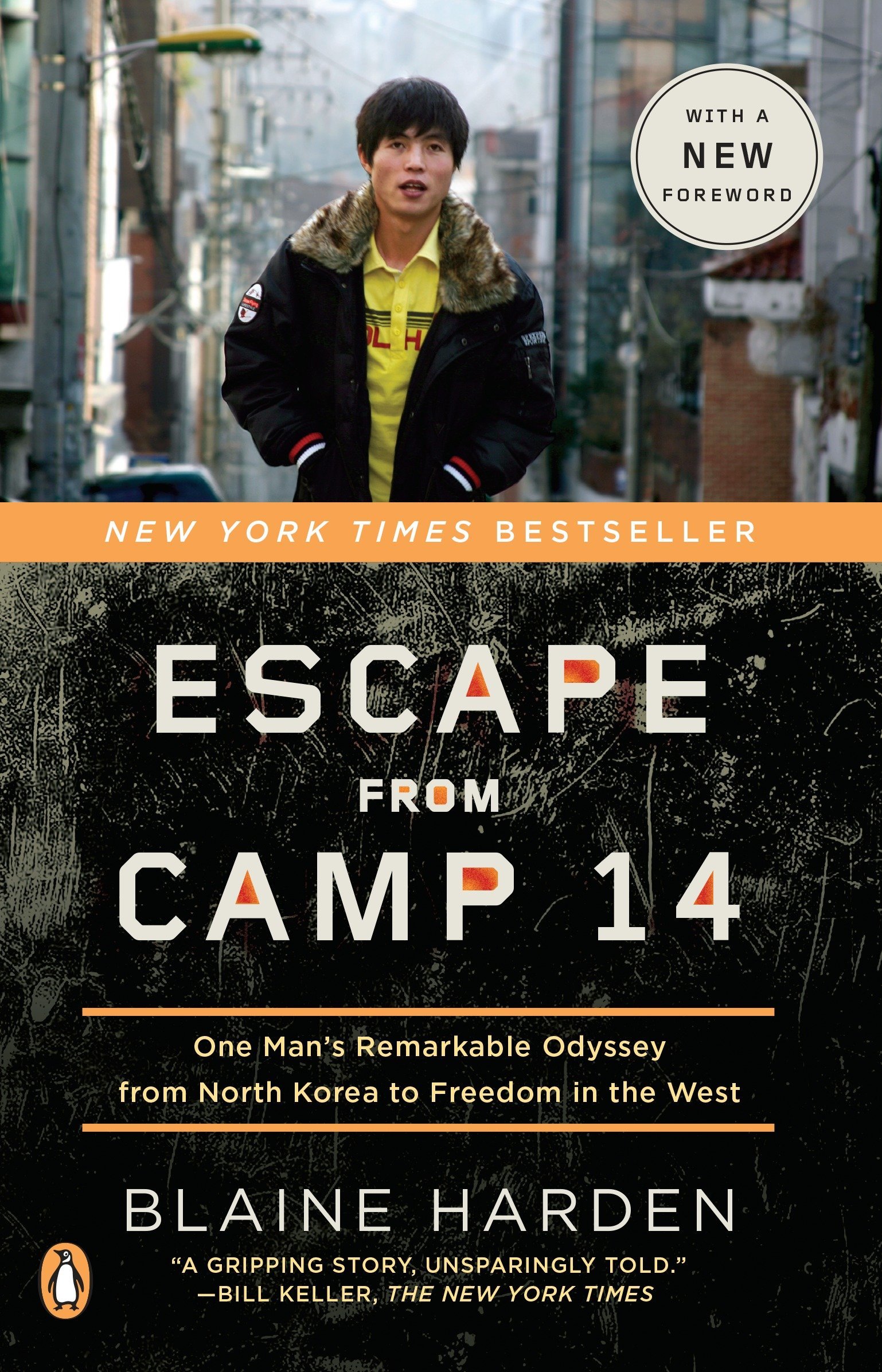
Escape from Camp 14: Chapters 13–19
Journalist Blaine Harden recounts the life of Shin Dong-hyuk, a young man who made a daring escape from a North Korean prison camp.
Here are links to our lists for the book: Preface–Chapter 4, Chapters 5–12, Chapters 13–19, Chapter 20–Appendix
40 words
148 learners
Learn words with Flashcards and other activities
Definition First

Other learning activities
Full list of words from this list:
-
trajectory
the path followed by an object moving through spaceHe said he had grown up in a large, comfortable apartment in Pyongyang and had followed the privileged educational trajectory of North Korea’s elites, studying in East Germany and the Soviet Union.
-
apparatchik
a communist who was a member of the administrative system of a communist partyPark said he lost his position as head of taekwondo training in Pyongyang in 2002, after squabbling with a midlevel apparatchik who apparently snitched on him to higher-ups in the government.
-
seditious
inciting action or rebellionPark asked why he was so afraid of a little song when he was willing to hear seditious stories about how Kim Jong II was a thief and North Korea was a hellhole.
-
solstice
when the sun is at its greatest distance from the equatorThe lyrics of “Song of the Winter Solstice,” which recent defectors say is the theme song of a popular program on North Korean state television, are about traveling companions who endure hardship and pain.
-
incendiary
inciting action or rebellionPark’s spirit, his dignity, and his incendiary information gave Shin something that was both enthralling and unbearable: a context, a way to dream about the future.
-
paranoia
a mental disorder characterized by delusions of persecutionEven after Park embraced the idea, Shin’s paranoia was difficult to shake: he had sold out his own mother; why shouldn’t Park sell him out?
-
dilapidated
in a state of decay, ruin, or deteriorationIn 1999, during the governmental breakdown and security lapses that marked the height of the North Korean famine, he hid under a metal panel wedged into the bottom of a dilapidated train car that was being loaded with coal.
-
loathing
hate coupled with disgustBy the unforgiving calculus of relations between distant fathers and resentful sons, that was reason enough for Shin’s loathing.
-
imperil
pose a threat to; present a danger toHe had told himself, as he walked to see his father, that any show of emotions, any hint of final leave-taking could imperil the escape.
-
meager
deficient in amount or quality or extentAfter Shin was assigned to the garment factory, where opportunities to find or steal extra food were particularly meager, his father had gone to the extraordinary trouble of obtaining the rice flour and sending it to his son as a paternal offering.
-
propaganda
information that is spread to promote some causeThe cult of personality surrounding the Kim family began with the Great Leader, KIM IL SUNG, who was depicted in government propaganda as a loving father to his people.
-
scavenge
collect discarded or refused materialChildren in the camps scavenged constantly for food, eating rats, insects, and undigested kernels of corn they found in cow dung.
-
camaraderie
the quality of affording easy familiarity and sociabilityHe liked the semichaotic camaraderie of group houses, where up to sixteen young people lived and ate together.
-
oblivious
lacking conscious awareness ofAs Shin worked and waited, he brooded about how the other prisoners were oblivious to the fence and the opportunities that lay beyond it.
-
passivity
the trait of remaining inactive; a lack of initiativeThey were like cows, he thought, with a cud-chewing passivity, resigned to their no-exit lives.
-
impale
pierce with a sharp stake or pointThe fences that surround some of the labor camps in North Korea include moats with spikes designed to impale anyone who falls in, according to Kwon Hyuk, a defector who worked as a manager at Camp 22.
-
siphon
convey, draw off, or empty by or as if by a tubeWith Park siphoning off current and funneling it to the ground, the level of voltage that Shin was exposed to as he crawled over his friend’s back was probably not close to being lethal.
-
itinerant
traveling from place to place to workIn a country where a third of the population were chronically malnourished, where local markets and train stations were crowded with filthy itinerant traders, and where almost everyone has served in the army, Shin easily blended in.
-
temerity
fearless daringWhen they had the temerity to laugh together in the streets or wear brightly colored clothes or haggle over prices in an open-air market, he expected armed men to step in, knock heads, and stop the nonsense.
-
eavesdrop
listen without the speaker's knowledgeOn the road, Shin encountered several worn-looking men and eavesdropped on their conversations.
-
ubiquity
the state of being everywhere at onceBut in the aftermath of the famine—with the collapse of the state-run economy, the rise of private markets, and the near ubiquity of traders hustling around the country with goods smuggled from China—laws were often ignored.
-
defection
the state of having rejected a causeThere are no reliable numbers on defections to China, or on the movement of people drifting around inside North Korea.
-
repatriate
send someone back to his homeland against his willIt depends on how recently the North Korean government has ordered a security crackdown, how vigilant Chinese authorities are in repatriating defectors, how willing border guards are to take bribes, and how desperate North Koreans are to cross the border.
-
affluent
having an abundant supply of money or possessions of valueThis new breed of brokers would often receive advance payment in cash from affluent or middle-income South Korean families seeking the release of a relative.
-
infiltrate
enter a group or organization in order to spy on the membersHe supervised undercover agents who pretended to be brokers and guides in order to infiltrate and disrupt the smuggling trade.
-
cache
a secret store of valuables or moneyAs he walked out of Bukchang that day, wearing his newly stolen coat and carrying a small cache of cookies, Shin joined a small group of traders that by chance was going north.
-
collude
act in unison and in secret towards a deceitful purposeSavvy operators within these organizations diverted trucks and colluded with smugglers to import fleets of secondhand cars, vans, and buses from China.
-
incarcerate
lock up or confine, in or as in a jailInstead of holding political criminals for life, these camps briefly incarcerated—and occasionally tortured—traders who failed to pay bribes to security officials.
-
threadbare
thin and tattered with ageWhen they finished their noodles, the young man said his family’s apartment was just around the corner, but that he was embarrassed to greet his parents wearing threadbare clothes.
-
abduct
take away to an undisclosed location against their willShe had been abducted from her hometown in Japan on August 12, 1978, as part of a long-running and long-concealed North Korean operation that snatched young Japanese from coastal communities.
-
coffer
the funds of a government, institution, or individualFood aid from China and the World Food Program was also flooding into state coffers—and some of it ended up in street markets.
-
leniency
mercifulness as a consequence of being tolerantThat tolerance became semiofficial policy in 2000, when North Korea promised leniency to those who had fled the country in search of food.
-
remittance
a payment of money sent to a person in another placeIt was a belated admission that tens of thousands of famine-stricken North Koreans had already gone to China and that the country was increasingly dependent on their remittances.
-
premeditated
characterized by deliberate purpose and a degree of planningNorth Korea’s news agency denounced the flight as “premeditated allurement, abduction, and terrorism.”
-
deride
treat or speak of with contemptAbout the same time, Congress passed a law that accepted North Korean refugees for resettlement in the United States, which the North derided as an attempt to topple its government under the pretext of promoting democracy.
-
bedraggle
make wet and dirty, as from rainBut he was lucky: orders from on high had not yet changed the bribe-hungry behavior of the four bedraggled soldiers Shin met at guard stations along the Tumen River.
-
cull
look for and gatherHe counted seven of them—an eyebrow-raising number by the standards of North Korea, where the pet population had been culled by scavengers, many of them orphans, who stole, skinned, and barbecued dogs during the famine years.
-
rudimentary
being or involving basic facts or principlesThe young woman in the house—Shin found out she was the farmer’s mistress—cooked for him and taught him rudimentary Chinese.
-
opulent
rich and superior in qualitySouth Korean soaps—which display the fast cars, opulent houses, and surging confidence of South Korea—are classified as “impure recorded visual materials” and are illegal to watch in North Korea.
-
exodus
a journey by a large group to escape from a hostile environmentA mass exodus from North Korea could substantially depopulate the country, undermine its already inadequate capacity to grow food, and weaken—or perhaps even topple—the government.
Created on Wed Jan 28 19:56:17 EST 2015
(updated Wed Sep 05 17:36:24 EDT 2018)
Sign up now (it’s free!)
Whether you’re a teacher or a learner,
Vocabulary.com can put you or your class
on the path to systematic vocabulary improvement.