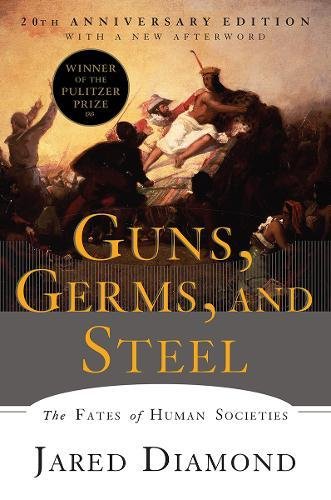
Guns, Germs, and Steel: Part IV: Chapters 18-19
In this Pulitzer Prize-winning book, Jared Diamond explores how geographical, biological, and environmental factors shaped the development of human societies.
Here are links to our lists for the book: Prologue-Part I, Part II: Chapters 4-7, Part II: Chapters 8-10, Part III: Chapters 11-12, Part III: Chapters 13-14, Part IV: Chapters 15-17, Part IV: Chapters 18-19, Epilogue-Afterword
35 words
48 learners
Learn words with Flashcards and other activities
Definition First

Other learning activities
Full list of words from this list:
-
indispensable
essentialIn Chapter 9 we encountered Eurasia’s 13 species, which became its chief source of animal protein (meat and milk), wool, and hides, its main mode of land transport of people and goods, its indispensable vehicles of warfare, and (by drawing plows and providing manure) a big enhancer of crop production.
-
bedraggled
limp, untidy, and soiledWhen Cortes and his bedraggled adventurers landed on the Mexican coast in 1519, they might have been driven into the sea by thousands of Aztec cavalry mounted on domesticated native American horses.
-
trivial
(informal) small and of little importanceBut the significance of all those species of small domestic animals was trivial compared with that of the big ones.
-
sow
place seeds in or on the ground for future growthIn those parts of the Americas that did support Native American agriculture, it was constrained by five major disadvantages vis-a-vis Eurasian agriculture: widespread dependence on protein-poor corn, instead of Eurasia’s diverse and protein-rich cereals; hand planting of individual seeds, instead of broadcast sowing; tilling by hand instead of plowing by animals...
-
paradoxical
seemingly contradictory but nonetheless possibly trueThis continental difference in harmful germs resulted paradoxically from the difference in useful livestock.
-
ancestral
of or inherited from someone from whom you are descendedMost of the microbes responsible for the infectious diseases of crowded human societies evolved from very similar ancestral microbes causing infectious diseases of the domestic animals with which food producers began coming into daily close contact around 10,000 years ago.
-
irrigate
supply with water, as with channels or ditches or streamsThe earliest advance over human muscle power was the use of animals—cattle, horses, and donkeys—to pull plows and to turn wheels for grinding grain, raising water, and irrigating or draining fields.
-
myriad
a large indefinite numberCoupled to systems of geared wheels, those engines harnessing water and wind power were used not only to grind grain and move water but also to serve myriad manufacturing purposes, including crushing sugar, driving blast furnace bellows, grinding ores, making paper, polishing stone, pressing oil, producing salt...
-
sextant
an instrument for measuring angular distanceMany Eurasian societies developed large sailing ships, some of them capable of sailing against the wind and crossing the ocean, equipped with sextants, magnetic compasses, sternpost rudders, and cannons.
-
polyglot
having a command of or composed in many languagesAmong these, the Habsburg, Ottoman, and Chinese states, the Mogul state of India, and the Mongol state at its peak in the 13th century started out as large polyglot amalgamations formed by the conquest of other states.
-
conquest
the act of defeating and taking control ofAmong these, the Habsburg, Ottoman, and Chinese states, the Mogul state of India, and the Mongol state at its peak in the 13th century started out as large polyglot amalgamations formed by the conquest of other states.
-
sanction
approve or show acceptance ofMany Eurasian states and empires had official religions that contributed to state cohesion, being invoked to legitimize the political leadership and to sanction wars against other peoples.
-
mnemonic
of or relating to the practice of aiding the memoryThe Inca Empire employed an accounting system and mnemonic device based on knots (termed quipu), but it could not have approached writing as a vehicle for transmitting detailed information.
-
trajectory
the path followed by an object moving through spaceBut those differences as of A.D. 1492 represent just one snapshot of historical trajectories that had extended over at least 13,000 years in the Americas, and over a much longer time in Eurasia.
-
virtual
being actually such in almost every respectEarly food production was less competitive with hunting-gathering in the Americas than in the Fertile Crescent or China, partly owing to the Americas’ virtual lack of domesticable wild mammals.
-
diffusion
spread of social institutions from one society to anotherEurasia’s east-west major axis, unlike the Americas’ north-south major axis, permitted diffusion without change in latitude and associated environmental variables. In contrast to Eurasia’s consistent east-west breadth, the New World was constricted over the whole length of Central America and especially at Panama.
-
contiguous
having a common boundary or edgeFor example, the Indo-European language family, which includes English as well as French, Russian, Greek, and Hindi, comprises about 144 languages. Quite a few of those families occupy large contiguous areas—in the case of Indo-European, the area encompassing most of Europe east through much of western Asia to India.
-
encompass
include in scopeFor example, the Indo-European language family, which includes English as well as French, Russian, Greek, and Hindi, comprises about 144 languages. Quite a few of those families occupy large contiguous areas—in the case of Indo-European, the area encompassing most of Europe east through much of western Asia to India.
-
barrier
anything maintaining separation by obstructing accessThus, we have identified three sets of ultimate factors that tipped the advantage to European invaders of the Americas: Eurasia’s long head start on human settlement; its more effective food production, resulting from greater availability of domesticable wild plants and especially of animals; and its less formidable geographic and ecological barriers to intracontinental diffusion.
-
strait
a narrow channel joining two larger bodies of waterThere were no Native American attempts to colonize Eurasia, except at the Bering Strait, where a small population of Inuit (Eskimos) derived from Alaska established itself across the strait on the opposite Siberian coast.
-
fjord
a long narrow inlet of the sea between steep cliffsBut most of Greenland is covered by an ice cap, and even the two most favorable coastal fjords were marginal for Norse food production.
-
subsidize
support, as through grants or other fundsSpain, unlike Norway, was rich and populous enough to support exploration and subsidize colonies.
-
throttle
place limits onAs a result, ships built and manned in Spain itself were able to sail to the West Indies; there was nothing equivalent to the Greenland bottleneck that had throttled Norse colonization.
-
moribund
not growing or changing; without force or vitalityOf the hundreds of Native American languages originally spoken in North America, all except 187 are no longer spoken at all, and 149 of these last 187 are moribund in the sense that they are being spoken only by old people and no longer learned by children.
-
unrepentant
not feeling or expressing remorseSurely, I thought, no country could be so dominated by unrepentant Nazis as to name a street after the notorious Nazi Reichskommissar and founder of the Luftwaffe, Hermann Goering!
-
wrest
obtain by seizing forcibly or violently, also metaphoricallyHow can we ever hope to wrest the answers to those questions from Africa’s preliterate past, lacking the written evidence that teaches us about the spread of the Roman Empire?
-
facetious
cleverly amusing in toneBut all those 500 Bantu languages are so similar to each other that they have been facetiously described as 500 dialects of a single language.
-
engulf
flow over or cover completelyPeoples who, by accident of their geographic location, inherited or developed food production thereby became able to engulf geographically less endowed people.
-
laden
filled with a great quantityWhen Europeans reached sub-Saharan Africa in the 1400s, Africans were growing five sets of crops, each of them laden with significance for African history.
-
fraught
filled with or attended withAs we’ll see, that reality was as fraught with consequences for African history as was the absence of native domestic plants in subequatorial Africa.
-
intrinsic
belonging to a thing by its very natureThe survival of modern Africa’s four native language families (that is, the four other than the recently arrived Austronesian language of Madagascar) isn’t due to the intrinsic superiority of those languages as vehicles for communication.
-
subdue
put down by force or intimidationEven though Europeans by then could supply troops from their secure base at the Cape, it took nine wars and 175 years for their armies, advancing at an average rate of less than one mile per year, to subdue the Xhosa.
-
docile
easily handled or managedBut we saw in Chapter 9 that a wild animal, to be domesticated, must be sufficiently docile, submissive to humans, cheap to feed, and immune to diseases and must grow rapidly and breed well in captivity.
-
submissive
inclined or willing to give in to orders or wishes of othersBut we saw in Chapter 9 that a wild animal, to be domesticated, must be sufficiently docile, submissive to humans, cheap to feed, and immune to diseases and must grow rapidly and breed well in captivity.
-
impede
be a hindrance or obstacle toAfrica’s north-south axis also seriously impeded the spread of livestock.
Created on Thu Aug 31 20:54:48 EDT 2017
(updated Fri Sep 29 08:37:56 EDT 2017)
Sign up now (it’s free!)
Whether you’re a teacher or a learner,
Vocabulary.com can put you or your class
on the path to systematic vocabulary improvement.